As a former principal, I know how much of a teacher's week goes into planning. This post walks through each part of the lesson cycle, from the bell ringer to the closure, and shows which ready-to-use materials fit each step. It's written for middle and high school teachers who want a simple plan they can repeat every week.
Overview of Lesson Planning
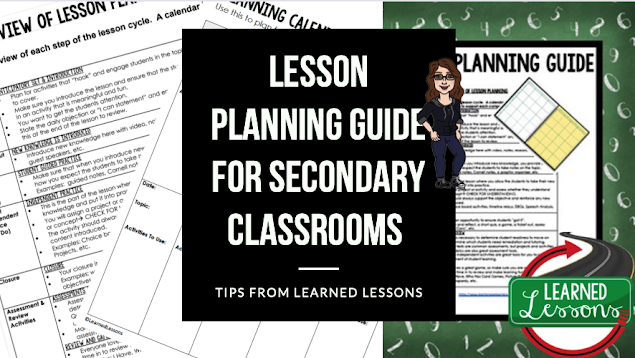
This is an overview of each step of the lesson cycle. A calendar is included and a guide to find great and ready to use resources to support each component of the lesson cycle.
Bell ringers & Introduction | ANTICIPATORY SET & INTRODUCTION · Plan for activities that “hook” and engage students in the topic you are going to cover. · Make sure you introduce the lesson and ensure that the students are engaged in an activity that is meaningful and fun. · You want to get the students' attention. · State the daily objection or “I can statement” and ensure you come back to this at the end of the lesson to review. |
Teacher Input (I Do) | NEW KNOWLEDGE IS INTRODUCED · Introduce new knowledge here with video, notes, research, presentation, guest speakers, etc. |
Students Guided Practice (We Do) | Student Guided Practice · Make sure that when you introduce new knowledge, you provide an outline of how you expect the students to take notes on the topic. · Examples: guided notes, Cornell notes, a graphic organizer, etc. |
Student Independent Practice (You Do) | Independent practice · This is the part of the lesson where you allow the students to take their new knowledge and put it into practice. · You will assign a project or activity and assess whether they understand the skill or conceptà CHECK FOR UNDERSTANDING. · The activity should always support the objective and reinforce any new content introduced. · Examples: Choice board activities, timeline relays, DBQs, Speech Analysis, Projects, etc. |
Closure | CLOSURE · Your closure is an opportunity to ensure students “got it”. · Examples: write and reflect, a short quiz, a game, a ticket out, assess objectives or “I Cans”, etc. |
Assessment & Review Activities | ASSESSMENTS AND REVIEW · Assessment is necessary to determine student readiness to move on and to determine which students need remediation and tutoring. · Quizzes and tests are common assessments, but projects and activities with clear rubrics are also great assessment tools. · Many of the independent activities are great tools for you to conduct a daily assessment of student learning. REVIEW AND GAMES · Everyone loves a great game, so make sure you are constantly embedding time in to review and make learning fun. · Examples: I Have, Who Has Card Games, Picture Puzzles, Matching Activities, Jeopardy, etc.
|
This is an overview of materials sold by Learned Lessons Teaching Resources. Many of these activities are included in bundles, so make sure you read the descriptions carefully to ensure you get the most for your money. CLICK ON LINKS TO SEE MATERIALS AVAILABLE.
Bell ringers & Introduction | Vocabulary PowerPoint and Student Vocabulary Outlines -Have a few word up each day for students to record in their vocabulary outlines. These pages should be kept and used to study and complete activities throughout the unit.
Anchor Charts -Create questions and give student copies or post around the classroom and have students answer questions from the charts. They could also be used as a closure or homework activity. -Print 2 or 4 to a page and post into interactive notebooks.
Social Studies Anchor Charts Science Anchor Charts ENGLISH ANCHOR CHARTS
I Can Student Self-Assessment of Mastery à Great for bell ringer review and to have student document the topic they are learning about, then review again at the end of the class to self-determine their level of mastery. These are also great with the included scavenger hunts to review content before a test.
Science I Cans Statement Social Studies I Can Statements |
Teacher Input (I Do) | Teacher Notes PowerPoint and Student Guided Notes (INCLUDED IN ALL BUNDLES) -Each day review a section of notes and have students used the guided notes packet to follow along. Students will have a complete packet of organized and easy to study notes and vocabulary at the end of the unit and to use throughout the unit in completing activities. -You could also print these 2 to a page for interactive notebook inserts. |
Students Guided Practice (We Do) | Student Guided Notes -Students can use these notes to follow along and actively participate during the “Teacher Input” section of the lesson. -You could also print these 2 to a page for interactive notebook inserts. Science Guided Notes Social Studies Guided Notes |
Student Independent Practice (You Do) | Choice Boards Activities -Assign these as needed to support instruction daily or allow students to choose which activities to complete. -Paper and Digital Versions are provided for each unit. Social Studies Choice Boards Science Choice Boards
Timeline or Sequencing Relay Activities -Use these cards to engage students in sequencing historical events or scientific processes. These can be used in groups or individually. -Paper and Digital Versions are provided if included in unit. Social Studies Timelines
Document Based Questions (DBQ) -Great for independent practice and assessment. Social Studies DBQs and Speeches
|
Closure | Anchor Charts -Create questions and give student copies or post around the classroom and students answer questions from the charts. They could also be used as a closure or homework activity.
I Have, Who Has Game Cards -These are great to use with the entire class as a review or daily during Guided Practice to review and drill vocabulary knowledge. -I suggest classes time themselves on how quickly they can put them in the correct order and try to beat their own time or another class or groups time throughout the unit.
|
Assessment & Review Activities | I Have, Who Has Game Cards -These are great to use with the entire class as a review or daily during Guided Practice to review and drill vocabulary knowledge. -I suggest classes time themselves on how quickly they can put them in the correct order and try to beat their own time or another class or groups time throughout the unit. Social Studies Picture Puzzles Social Studies Games Science Picture Puzzles Science Games
Puzzlesà -Great for review or independent or group practice.
Vocabulary Matching Cardsà -Great for review or independent or group practice.
Document Based Questions (DBQ) -Great for independent practice and assessment.
|
Additional Activities by Learned Lessons that are included in some mega bundles and coming soon for others. | Social Studies Pennant Word Walls with activity pages Science Pennant Word Walls with activity pages -Great for classroom decoration. |
A tip from my classroom
Plan your closure before anything else. Once you know how students will show you they got it at the end of class, it's much easier to choose the notes and practice that lead there. I write the closure question right under the I Can statement on my plan so the two always match.
Find more of my teacher and principal resources in this guide.
See every lesson planning guide resource in my shop: browse the collection.
Find a year-long curriculum designed for middle and high school classrooms.
More Resources from Learned Lessons Teaching Materials
✔ Guided Notes & PowerPoints
✔ Bell Ringers & Warm-Ups
✔ Escape Rooms
✔ Word Walls
✔ Choice Boards
✔ Collaborative Posters
✔ DBQs
✔ Mapping Activities
✔ Assessments
✔ Digital Google Classroom Resources
Stay Connected
🛍️ Shop TpT or 🛍️ Memberships Site
✉️ Email Updates
📸 Instagram
📌 Pinterest
📘 Facebook
🎵 TikTok
📝 Blog
✉️ learnedlessonstpt@gmail.com
Teaching Made Easier.
Learning Made Meaningful.
Print • Digital • Google Classroom • No Prep


THis is awesome for new teachers or even seasoned teachers. it is so comprehensive...Thanks for sharing!
ReplyDeleteThis is awesome! Thanks for sharing!
ReplyDeleteThe details here are wonderful! Thank you!
ReplyDeleteThank you for sharing! :)
ReplyDelete